
🔦 Emerging Writer Interview: Isabel Cristo 🔦
"These things might mean more to us than we’re prepared to admit"


Fashion Fiction Magazine is the digital companion to a regular, in-person reading series, which celebrates literary fashion writing from the past and present. Participants can read something they wrote, or something someone else wrote, it just has to have fashion and clothes as its starting point. These events usually sell out quickly, and are not recorded.
Here, you’ll have access to a sprawling library of literary fashion writing, and will be the first to know about upcoming events.
Hi!
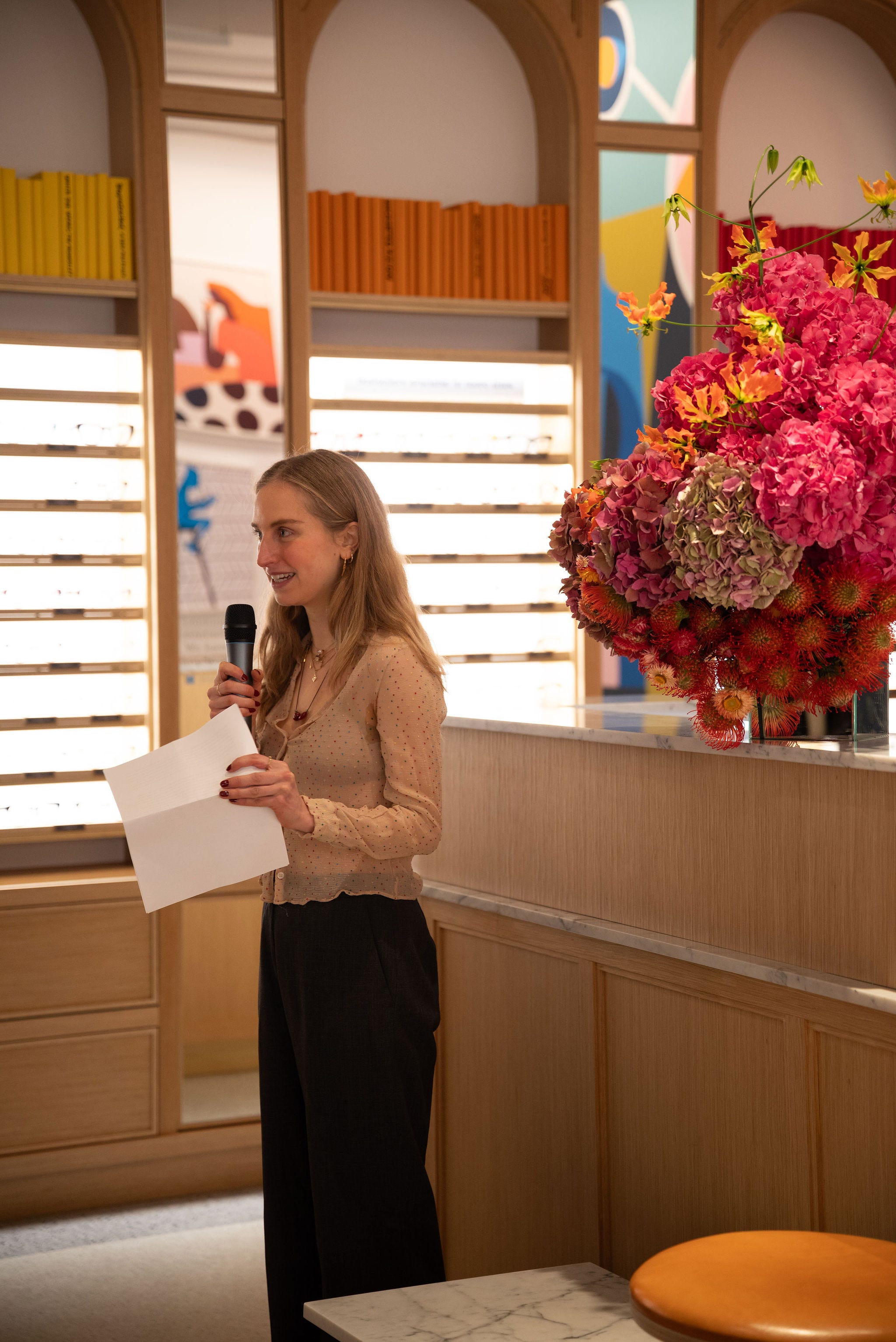
If you attended the last Fashion Fiction event you were lucky enough to see my genius friend Isabel Cristo read. Isabel was our emerging reader, but as with our other emerging readers, that title doesn’t quite fit. She is a very talented fact-checker at New York Magazine, and also writes brilliantly about leftist politics, aesthetics, and much much more. I really love the way she writes and thinks about clothes, though, and was delighted that she shared her piece On Getting Dressed, which was published in the Paris Review in 2024, which you can read here. Isabel also read from a novel she is working on, which you cannot read here, and if you weren’t at the reading, you will just have to wait for the day when you can pluck it off the bestseller wall at your local bookstore.
Fashion Fiction Intern, Mia Foster, spoke to Isabel about the two pieces she read, the way her day job as a fact checker interacts with the way she feels about getting dressed, the relationship between progressivism, and so much more. I hope you enjoy their conversation as much as I did.
If you are an emerging fashion writer who would like to read at a Fashion Fiction event, or you are interested in publishing your work in Fashion Fiction Magazine please get in touch! I would love to hear from you.
Love,
Mikaela
Mia Foster: I was wondering how [The Paris Review] essay came to be. When you started writing it, how you were thinking about the structure and what details you were including, etc.
Isabel Cristo: Sometimes I think that the two most intellectually rigorous things that I do every single day are get dressed and make dinner. Just the mental real estate that those two things occupy really cannot be overstated.
Working in media, it became clear to me that so much of fashion writing is business reporting or fashion criticism, which is really valuable but not something that I have a lot of access to as someone who’s not seeing the shows. It’s sort of an idiosyncratic creative expression. Unlike a film or a book, it’s a nondemocratic and nonegalitarian thing to engage with, even just as a consumer, let alone as a critic. So it made sense to me to turn to prose as a way to work out my own obsessions.
When I think about why I love clothes so much, and why I spend so much time running through the minutia of such a quotidian experience, I started to find a lot of humor in the neuroses and I wondered, surely, if I’m thinking this way, then there must be thousands of other people who are having an analogous sort of process. And wouldn’t it be nice if we could treat that process as a rich arena of writing and exploration, just as much as designer shows? That was the starting point. Honestly, I just found it to be such a funny and bizarre way of being honest with yourself. And I wondered if that would resonate with anyone.
MF: One of the things that I was curious about was how your work as a researcher and fact checker is similar in any way to how you get dressed. They both require this meticulous and thoughtful attention, and I was wondering if those processes were analogous for you.
IC: I think that they’re inversely related. In my work, I have to bring a certain amount of rigidity, and I have to always be thinking about the worst-case scenario. I orient myself towards safety and conservatism with the hope and the understanding that, as a cog in the machine of generating a story, it will not turn out to be rigid or conservative or safe, but that my job is to pull everyone towards safety.
I really hope that I don’t get dressed like that. When the process happens at its best, it’s one where I leave the house and I think ‘maybe I wore the wrong thing, but there’s always tomorrow.’ You have to have a certain level of play for it to be the right outfit and for it to feel like a worthy intellectual pursuit. You come at it with a level of experimentation and treat every outfit like a hypothesis.
MF: That’s interesting. One of the things that you talk about a little bit in the piece is being frivolous. But you also say, “it can be wonderful to choose to be a part of something bigger than yourself.” I was wondering if you could expand on that a bit.
IC: I have a real personality deficiency: I love spending money. But I have such a hard time spending money on things that I can’t keep in my hands. The thing about spending my money on clothes is that my mom taught me that it’s a good thing to do and that it’s a private experience that you have. For me, it’s a very literal way of relating my labor output to what I get from life and from the world. When it comes to frivolousness, the funny thing about that word is that in many ways, as evidenced by the piece, I take it seriously, what I buy, what I don’t buy, but I understand that it’s not a basic need, and I understand the systems that have to exist to allow me to buy beautiful things. Simultaneously, I take those systems very seriously. I think that’s an essential tension of modernity. What does it mean to live beautifully and aesthetically and thoughtfully, when you have access to everything all at once? I’m interested in continuing to indulge that tension, not burying my head in the sand about it.
MF: Mikaela mentioned that you guys were talking about squaring one’s politics with one’s consumption habits. You’ve been bringing it up in the other questions, but I’m curious about this tension between frivolity and one’s politics.
IC: A question that we were identifying is: why is there this milieu of women who I see as being deeply rooted in the left, in a place like New York City, who are also obsessed with luxury designer clothing? How does that interplay between egalitarianism and universalism sit in our bodies when the whole point of luxury design is exclusivity? Luxury, definitionally, is something that is available only to the few, and that is intrinsically and inextricably linked to social status, which is something that the left is invested in trying to disrupt.
Maybe it’s as simple as there’s something sexy about playing with taboo, and there’s something safe about luxury clothing as an arena where you can engage with social hierarchy, status, exclusivity, and inclusivity. Maybe that’s deemed to be an appropriate place to work out those feelings, which I see as brilliant and intoxicating. Quite frankly, I’ve made dear friends because they came up to me at a party and said, “I love your handbag” or something. It would feel disingenuous to say that there is not a social element to the process of getting dressed.
MF: That was something that I was thinking about when reading your piece, the details that you choose are so specific, and in many ways, bring up questions about how we relate to one another through our clothes.
IC: I hope that people are encouraged to ask themselves questions, ‘Why do I always go towards this shape when I want to impress someone?’ We all have those things, and I’m interested in encouraging all of us to notice those things about ourselves, because it’s a practice of attention.
MF: I wanted to go back to something you said earlier. You were mentioning that clothes matter to you because your mom said it’s something that you can do for yourself. I was curious about the development of your style, and when you first knew that you loved clothes.
IC: That’s a really sweet question. I think that for me, a lot of it came out of constraint. The only way that I shopped as a kid was thrifting and secondhand. From the very beginning, shopping was a process of choosing. There’s something existentially challenging about thrift stores. If you really get acclimated to that, you train yourself to think, none of this stuff was meant for me initially, so how do I find myself in this secondary market?
When you go to a retail store, you’re being told something about what clothes should be, how they should look, and which ones are meant for you, even if that’s as simple as the sizing. There are orthodoxies that are inherent to those spaces and the thrift is pure entropy. You have to think, ‘what kind of a person am I that I’m choosing this top and not this top, because they both are $8 and they both are not my size.’ There’s just more layers to it.
My mom is a professional dancer and has a lot of rules for herself about what she wears. Whether or not they were rules that I took on myself, she really modeled for me what it looks like to think really carefully about your body as a site of expression.
MF: My last question is about the novel you’re working on. I’d love to hear about what that project is and how it came about.
IC: It’s about a performance artist in the early 90s, and her teenage daughter. The girl is about to leave the city, and decides she wants to find out who her biological father is. So she comes up with a list of potential candidates. If you know anything about the New York avant-garde art scene in the 70s, 80s, and 90s, you will recognize all of those characters as real men: a painter, an art collector, etc. The way that she determines which one of them is her father is by trying out each of their artistic practices and seeing which one of them speaks to her preternaturally. It’s kind of a coming-of-age [story].
A lot of stuff is drawn from my parents’ experience being in New York in the early ‘90s. The mother character is a composite of performance artists and choreographers my mom worked with, but really is inspired by one woman I met in France a number of years ago. The choreographer was the most glamorous and intense woman I’ve ever met, and she was there with her little daughter and their nanny, a Cyprian anarchist. I couldn’t stop thinking about this triad of women; the artist mother who has the nanny because she has to travel the world to make her art, the young radical who’s co-parenting her child, the daughter who will grow up around adults all over the world. I was curious what that would do to one’s sense of self.
I’ve been craving being taken to a different time and place from fiction. I decided to write something that I wanted to read, something that privileges storytelling over showcasing literary talent. Jury’s still out on if I have any, but at least I like the story.
MF: That’s amazing. That makes me think about what you were saying about making up stories about the clothes that we wear. And there’s something really beautiful about being free to tell ourselves stories about the things that we care deeply about.
IC: I think so much stuff that feels like it’s preparation for life — like getting dressed or feeding yourself, or talking to your mom on the phone — doing these things might mean more to us than we’re prepared to admit.
 | A guest post by |